



Grant opportunity for Arab American organizations
The Center for Arab-American Philanthropy (CAAP) is offering support and capacity-building grants ranging from $5,000 to $20,000 for Arab American organizations.
Funds are available through individual donors and support from the W.K. Kellogg Foundation.
The deadline to apply for grants is Feb. 28.
Three conference calls providing information on applying are scheduled for Jan. 14 at 3 p.m., Jan. 15 at 3 p.m. and Jan. 19 at 3 p.m. Contact Jamie Kim at 313.842.4756 or jkim@centeraap.org to participate in the calls.
For more information on the grant opportunity and the Center for Arab American Philanthropy, which is housed at ACCESS in Dearborn, visit www.centeraap.org.
Grant awards will be announced in May, 2009.
Fundraiser for Gaza hospital to be held in Dearborn
A fundraising drive for the Shifa hospital and other humanitarian causes in Gaza is to be held at Riverside Academy, 7124 Miller Road in Dearborn, on Saturday Jan. 10 at 5 p.m.
The group Palestinian Unity organized the effort. Funds are to be sent to Gaza through the Palestinian Aid Society, www.palestineaidsociety.org for medical aid and ten group Islamic Relief, www.irw.org, for humanitarian aid.
According to aid workers, doctors in Gaza are struggling to treat the injured and are lacking essential medical supplies. Gaza’s 1.5 million residents were already facing the region’s worst humanitarian crisis in 30 years before the current crisis, exacerbated by the limited mobility of aid workers, depleted supplies and a massive increase of those in critical need.
California-based aid organization Islamic Relief has launched a multi-million dollar humanitarian appeal to ease suffering in the ongoing crisis. The group has an established, internationally recognized office and staff in Gaza able to provide medicine and food aid.
“The children are terrified. Adults are unable to provide them with security or warmth. Hospitals are stretched out of the limits. We need blood and medicine and surgical equipment,” said Eyad El-Sarraj, director of the Gaza Community Mental Health Program.
Other fundraising efforts through Islamic Relief and other groups are being organized locally.
Check www.arabamericannews.com for updates and the online community calendar for more aid events.

|
|
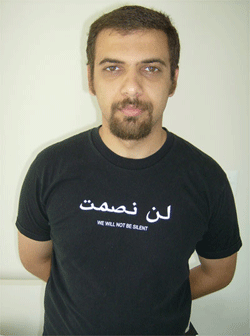
Raed Jarrar |
JetBlue Airways and two Transportation Security Authority officials have paid out $240,000 to the Iraqi-born blogger Raed Jarrar, who sued after he was stopped from boarding a JetBlue flight at JFK Airport because he was wearing a t-shirt that said “We will not be silent” in both Arabic and English.
Last year, the American Civil Liberties Union and the New York Civil Liberties Union filed a federal civil rights lawsuit on Jarrar’s behalf.
ACLU attorney Aden Fine said, “This settlement should send a clear message to all TSA officials and airlines that they cannot discriminate against passengers based on their race or the ethnic content of their speech.”
The settlement was announced just days after the airline AirTran removed a Muslim family of nine heading to Orlando. AirTran refused to let the family fly on the airline even after they were questioned and cleared by the FBI.
-From Democracy Now
MLK scholarship deadline for applications approaching
Arab and Chaldean Americans from Michigan have until 4:30 p.m. on Jan. 15 to deliver their applications and essays for a 2009 American-Arab Anti-Discrimination Committee (ADC) Michigan Martin Luther King, Jr. Scholarship.
The annual program has provided more than $100,000 in help with college costs over the last ten years. Individual awards usually ranging from $500 to $3,000.
Last year’s top awardee was Abbas Alawieh, of Dearborn, who was a 16-year-old Fordson senior.
“I write to you out of despair. Nothing and no one has been able to silence your just cries for a humane society, not even the bullet with which you were murdered,” Abbas wrote in his essay, a letter to Dr. Martin Luther King Jr.
The 10th anniversary ADC MLK awards reception, co-hosted by the NAACP, is to be held Jan. 30 at 6 p.m. at the Greenfield Manor Banquet Hall in Dearborn.
For more information, to download an application or for sponsorship information, visit www.adcmichigan.org or call 313.581.1201.
Local and national groups to stage Washington protest Saturday
A Washington D.C. protest against ongoing military attacks on Gaza organized by a large group of nationwide organizations is scheduled for Saturday, Jan. 10 at 1 p.m.
A crowd is expected to gather at the north side of the White House at Lafayette Park, 1600 Pennsylvania Avenue at 1 p.m.
The demonstration is to take place between the White House and the nearby Hay Adams Hotel, where President-Elect Barack Obama is residing.
The ANSWER Coalition, the National Council of Arab Americans, the Council on American Islamic Relations, Voters for Peace and many other groups are sponsoring the protest.
Groups from Dearborn, Flint and Rochester Hills and cities across the country are organizing transportation. Visit www.answercoalition.org for information.
Annual Detroit MLK march to feature Arab American speaker on Gaza
The 6th Annual Detroit Dr. Martin Luther King, Jr. Day Rally and March is to take place Jan. 19 at Central United Methodist Church, 23 East Adams Avenue in Detroit.
Marking the 80th birthday of the late civil rights and peace activist, the MLK day rally starts at noon, followed by a march through the city’s downtown at 1:30 p.m.
The theme of the rally has been dubbed “Economic Justice and the Continuing Struggle for Civil Rights and Peace.”
Organizers said the occasion takes on extra significance with the election of the nation’s first African-American president, Barack Obama.
“Although this historical milestone has been achieved, the social efforts aimed at realizing a world without war, poverty, hunger, racism, sexism, national oppression, LGBT bigotry and economic exploitation continues,” organizers said in a release.
The event’s keynote speaker is Gloria House, a professor and director of humanities and African-American studies at the University of Michigan-Dearborn, who worked alongside King in 1960’s in Alabama.
Arab American community leader and publisher of The Arab American News Osama Siblani is also scheduled speak on the Gaza crisis and the struggle for equality and justice.
Contact the Detroit MLK Committee for information at 313.702.5558 or ac6123@wayne.edu.
Arab American artist to be featured in Pontiac
The Creative Arts Center in Pontiac, 47 Williams Street, opens an exhibition of paintings and ceramics entitled “Celebrations” by Ilham Baddredine Mahfouz on Jan. 9, continuing through Jan. 31.
An free opening reception at 6 p.m. on Jan. 9 will include a poetry reading by Ibaa Ismail and a violin performance by Lama Alghanem.
Free parking is available behind the center on Pike Street.
Mahfouz, a Bloomfield Hills resident originally from Syria, teaches painting and ceramics at the center and teaches Arabic at the University of Detroit Mercy.
“As we all face the hardships from the current economic crisis, and people are losing their jobs and heading for uncertainty, I just want to let you know that if one door is closed, 99 doors are opened, so focus on the 99 doors and forget about the closed one,” she said in a statement about the optimism the exhibit is meant to convey.
Visit www.artistilhambadreddinemahfouz.com for information on Mahfouz. Visit www.pontiac.mi.us/cac or call 248.333.7849 for information on the Pontiac Creative Arts Center.
Fourth part of refugee documentary to be screened
Part four of the six-part documentary film series “Chronicles of a Refugee” is to be screened at the Arab American National Museum on Jan. 14 at 6:30 p.m.
The documentary was filmed in over 15 countries with more than 250 interviews of Palestinian refugees who have lived in over 25 countries.
A $15 admission fee goes to benefit Palestinian charity efforts.
Visit www.arabamericanmuseum.org/filmchroniclesofarefugee for information or contact Mariam Arraf at mariam_arraf@yahoo.com or 586.808.8461.
Jewish Voice for Peace event to discuss observations from Palestine trip
Barbara Harvey, an American Jew and labor/civil rights advocate and lawyer, will report on current human rights, social, and economic conditions in the occupied Palestinian Territories through photographs and stories of her recent trip there at the Royal Oak Public Library, 222 East 11 Mile Road in Royal Oak on Saturday, Jan. 10 at 4 p.m.
Harvey is an organizers for the local chapter of the group Jewish Voice for Peace. Contact Harvey to RSVP or for information at blmharvey@sbcglobal.net or 313.779.9837.
News briefs compiled by Khalil AlHajal
Leave a Reply