29
RAMADAN 2011
The Arab American News
CNN
— Women living in refugee camps are em-
broidering clothes and accessories sold in high-end
department stores, through a business started by
a 27-year-old Pales nian woman.
Zeina Abou Chaaban runs a social business
called "Palestyle" selling embroidery made by
Pales nian women in refugee camps in Jordan and
Lebanon.
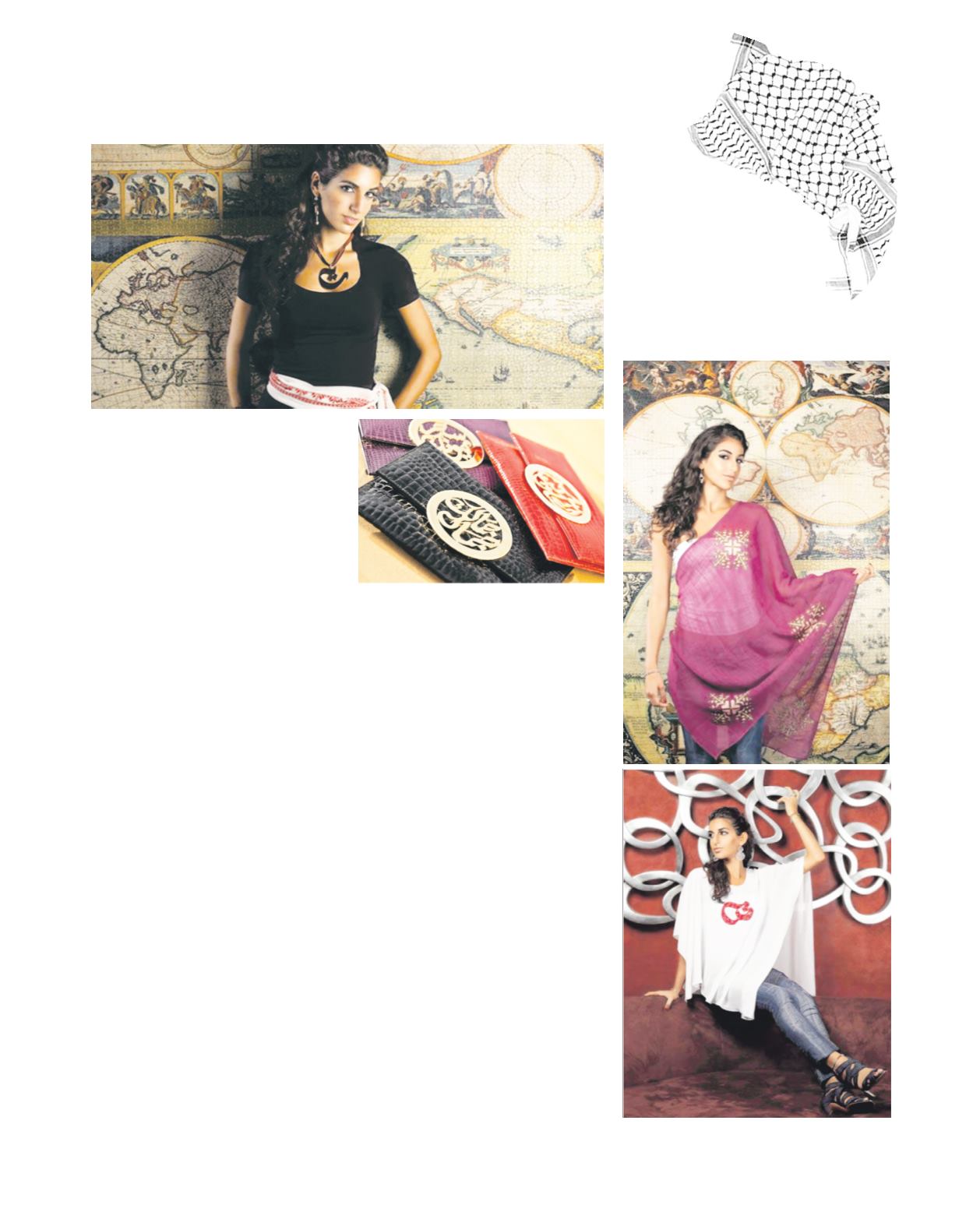
The designs, including clothing, bags, jewelry
and belts, are sold through Bloomingdales in
Dubai, and other stores in Bahrain, Abu Dhabi,
Qatar and the UK.
Abou Chaaban, a Pales nian woman living in
Dubai, said: "I wanted to spread the richness and
wealth of Pales nian culture, but in a trendy way.
"Usually embroidery is on very tradi onal
pieces, but we are trying to revive the embroidery
culture in a very modern way, using modern colors
and modern designs."
She set up the business two years ago and now
employs 40 women in refugee camps in Jordan and
Lebanon. NGOs working with women and children
receive 5% of all proceeds from Palestyle sales.
Life in the refugee camps is a far cry from the
high-end stores where the women's work is sold
for prices such as 850 Dirham ($230) for a leather
clutch, 550 Dirham ($150) for a shawl with gold-
plaited mo f and embroidery, or 195 Dirham ($53)
for a kafiya top with hand-made embroidery.
Abou Chaaban said: "The living condi ons in the
camps are very harsh with shortages of basics such
as water, electricity, food and schooling for chil-
dren. It's a struggle for the basics of life.
"The income they receive for the embroidery
helps them support their families and their kids'
schooling."
Inaash is another organiza on that has been
training refugee Pales nian women in embroidery
and selling their wares since 1969.
Jacqueline Khayat Inglessis, president of Inaash,
said: "We now have about 500 women in several
different Pales nian camps in Lebanon working for
us. Over the years we have trained more than
6,000 women.
"We want our heritage to stay and we are teach-
ing embroidery to the younger genera on."
Their work is sold through the Inaash cultural
center in Lebanon and exhibi ons worldwide.
Most of the women were born in the refugee
camps and have never been to the Pales nian Ter-
ritories, but s ll consider it to be home.
Inglessis said: "They are always thinking about
Pales ne, of their villages, their homes, their olive
trees, or what's le of them -- even the ones who
have never been there.
"They know where they came from and they
think that's home. Their dream is to go back.
"When they are embroidering, they feel Pales-
ne is with them. It's their roots. They are figh ng
with their needle."
Inglessis said women working for Inaash are
paid by piece depending on the size and complex-
ity of the embroidery.
Most of the women do the embroidery from
home in their spare me alongside looking a er
their homes and children.
"The money helps them a lot," said Inglessis.
"This is why they are always asking us for more
work and we do our exhibi ons and try to sell as
much as we can.
"It's a hard life in the camps. The professional
people in the camps, the doctors or engineers, can-
not work on their profession in Lebanon. They can
only work in low-grade work."
Inaash, like Palestyle, aims to give a modern
twist to tradi onal designs.
"The work is all based on tradi onal Pales nian
mo fs but nowadays we try to put more color in
them. We keep our old pa erns and mo fs so our
Pales nian heritage will stay alive," said Inglessis.
Visit
for more informa on.
"When they
are embroidering,
they feel Palestine is
with them. It's their
roots. They are
fighting with their needle."
Palestinian refugees making high fashion


