The Arab American News
RAMADAN 2011
20
Islamic make-over
for bus stops in
Pakistan
P
akistan is decora ng bus stops with Qur'anic
verses and Islamic calligraphy to give a more
spiritual flavor to the capital Islamabad, long
considered one of the country’s most liberal ci es.
The Capital Development Authority (CDA) plans
to roll out 100 new bus shelters — known locally as
sunshades — painted with flowers and religious
verses to spruce up the 1960s purpose-built capital.
“The new sunshades will not only provide pro-
tec on to commuters from inhospitable weather
but will also project the art of Islamic calligraphy and
our rich heritage,” CDA official Haji Mehboob Ahmad
told AFP.
The CDA intends to erect 30 in the next two
months, the ho est and we est of the year as the
monsoon season sets in, at a cost of 400,000 rupees
($4,700) each a er the public responded well to a
pilot program.
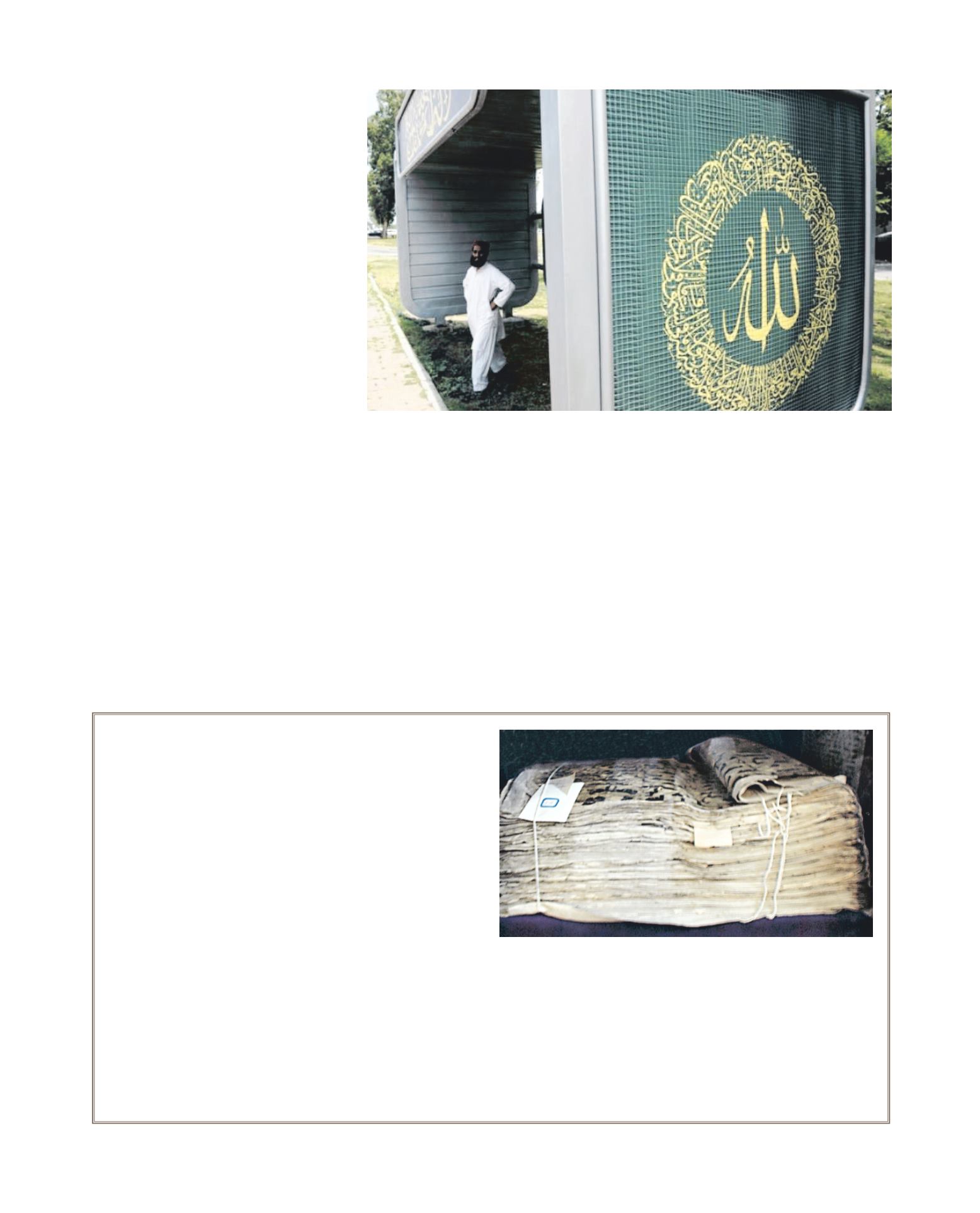
Set up near Islamabad’s commercial Blue Area,
not far from the seat of government, the first stop
has been lavishly painted green, purple and yellow,
inscribed with verses from the Qur'an seeking pro-
tec on from evil.
The name of God has been painted in Arabic cal-
ligraphy and there is a public service message ex-
hor ng bus users to respect public property.
“This bus stand belongs to you. Please take care
of this sunshade and keep your city green and
clean,” the message says.
The project has a racted local press a en on
and residents said they were fans of the new shel-
ters.
“It really looks great to see beau fully designed
sunshades with calligraphic art,” said Imran Hussain,
a telecommunica ons worker, wai ng at the new
bus stop surrounded by huge trees. “I have decided
to approach the CDA management to put up one in
an area where I live. It really looks beau ful.”
The municipality, which is heavily commi ed to
mega building projects such as new under-passes
and fly-overs in the growing city of more than one
million, says the bus stops have a prac cal benefit.
“These messages will be meant to enhance
awareness among people on crucial issues of water
conserva on, sanita on and an an -li ering cam-
paign,” CDA official Ramzan Sajid told AFP.
He said that the municipality was conduc ng de-
tailed surveys to designate appropriate places for
the new bus stops pending top-level approval.
The bus stop calligraphy inscribing names for God
has been inspired by renowned Pakistani calligra-
pher and painter Syed Sadequain Ahmed Naqvi.
Known interna onally for his skills, Mr. Sadequain
is credited with something of a renaissance in Is-
lamic calligraphy in Pakistan.
“We needed these sunshades to provide relief to
commuters using public transport from harsh
weather condi ons and to project our rich Islamic
heritage and message of Islam through Qur'anic
verses,” Mr. Sajid added.
Talib Hussain, a bearded student at a local
madrassa, is also a fan of the new bus stops. “It is
kind of a prayer to see and read verses and the
names of God wri en in calligraphic art on the sun-
shade,” he said.
— AFP
T
he Othman Qur'an (also termed the Othmanic codex, Othmanic re-
cension, Samarkand codex, Samarkand manuscript and Tashkent
Qur'an), named for the third Caliph, Uthman ibn Affan, is a manu-
script Qur'an kept in the Hast Imam library. Along with the Sana'a manu-
scripts, it is considered to be the oldest in the world.
This copy of the Qur'an is a ributed to the third caliph Uthman. In 651,
19 years a er the death of Muhammad, Uthman commissioned a commit-
tee to produce a standard copy of the text of the Qur'an. Five of these
original Qur'ans were sent to the major Muslim ci es of the era, with Uth-
man keeping one for his own use in Medina. The only other surviving copy
is said to be held in Topkapı Palace, in Turkey.
Uthman was succeeded by Ali, who took the Uthman Qur'an to Kufa,
now in Iraq. When Tamerlane destroyed the area, he took the Qur'an to
his capital, Samarkand, as a treasure. It remained there for four centuries
un l, in 1868, when the Russians invaded, captured the Qur'an and
brought it back to the Imperial Library in St. Petersburg (now known as the
Russian Na onal Library).
A er the October Revolu on, Vladimir Lenin, in an act of good will to
the Muslims of Russia, gave the Qur'an to the people of Ufa, Bashkor-
tostan. A er repeated appeals by the people of Turkestan ASSR, the
Qur'an was returned to Central Asia, to Tashkent, in 1924, where it has
since remained.
The parchment manuscript now is held in the library of the
Telyashayakh Mosque, in the old "Hast-Imam" (Khazra Imom) area of
Tashkent, Uzbekistan, close to the grave of Kaffal Shashi, a tenth-century
Islamic scholar.
The manuscript is incomplete, only a third of the Qur'an surviving: it be-
gins in the middle of verse 7 of the second sura and ends abruptly at Surah
43:10. The manuscript has between eight and twelve lines to the page
and, showing its an quity, the text is devoid of vocaliza on.
This photo shows a man wai ng for transport at a newly installed bus shelter in Islamabad.
Manuscript Qur'an
considered oldest in world
The manuscript is held at the Telyashayakh Mosque in Uzbekistand. It is a ributed to the
third caliph Uthman.


