Ramadan
20
10
34
Islamic Calligraphy
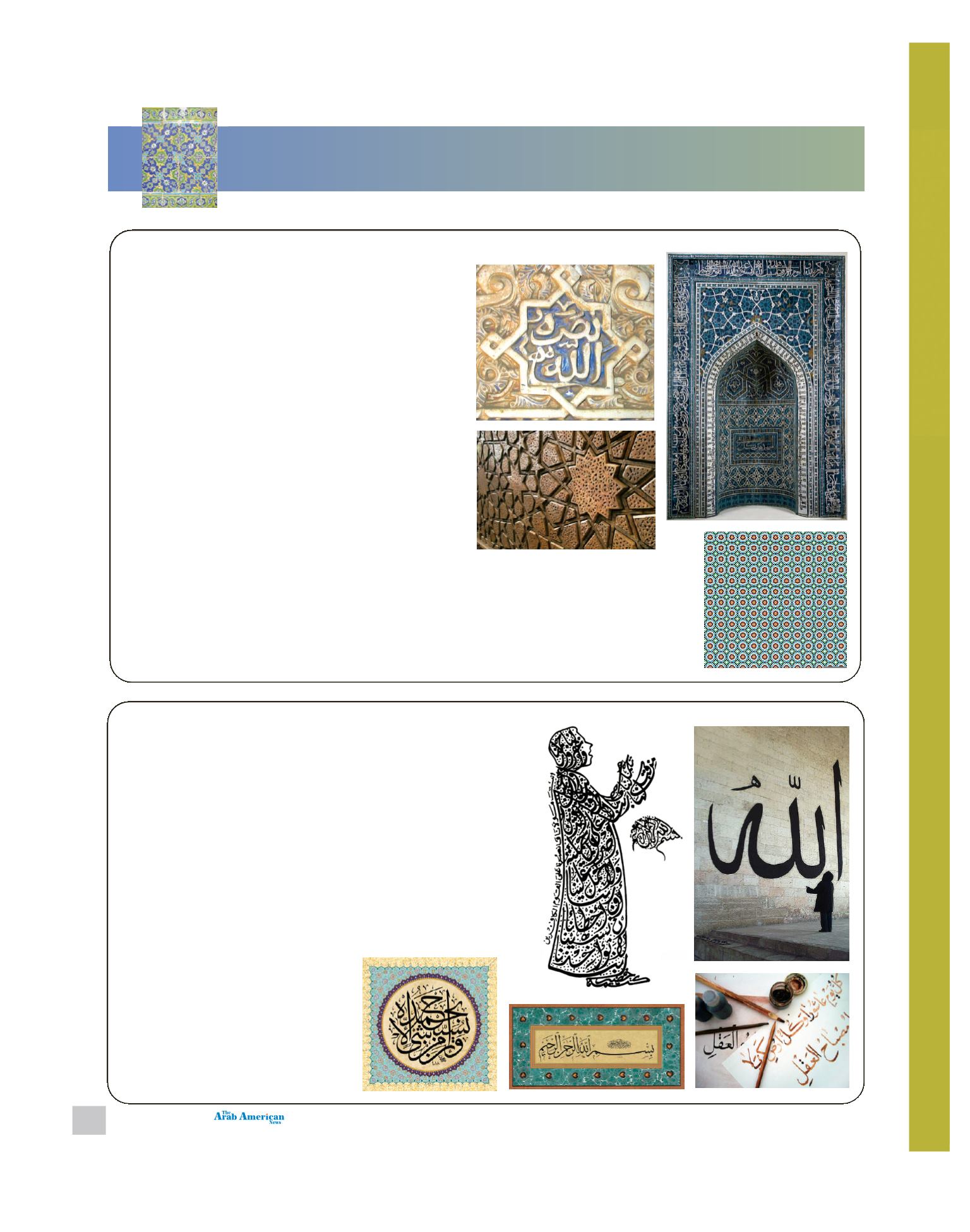
Calligraphy is the most highly regarded and most fundamental element of Islamic art. It
is significant that the Qur’an, the book of God's revelations to the Prophet Muhammad,
was transmitted in Arabic, and that inherent within the Arabic script is the potential for
developing a variety of ornamental forms. The employment of calligraphy as ornament
had a definite aesthetic appeal but often also included an underlying talismanic compo-
nent. While most works of art had legible inscriptions, not all Muslims would have been
able to read them. One should always keep in mind, however, that calligraphy is princi-
pally a means to transmit a text, albeit in a decorative form.
Objects from different periods and regions vary in the use of calligraphy in their over-
all design, demonstrating the creative possibilities of calligraphy as ornament. In some
cases, calligraphy is the dominant element in the decoration. In these examples, the
artist exploits the inherent possibilities of the Arabic script to create writing as orna-
ment. An entire word can give the impression of random brushstrokes, or a single letter
can develop into a decorative knot. In other cases, highly esteemed calligraphic works on
paper are themselves ornamented and enhanced by
their decorative frames or backgrounds. Calligra-
phy can also become part of an overall ornamental
program, clearly separated from the rest of the dec-
oration. In some examples, calligraphy can be com-
bined with vegetal scrolls on the same surface
though often on different levels, creating an inter-
play of decorative elements.
Source: Heilbrunn Timeline of Art History |
The Metropolitan Museum of Art
Islamic art @ a glance
Geometric Patterns
Geometric patterns make up one of the three nonfigural types of decoration
in Islamic art, which also includes calligraphy and vegetal patterns. Whether
isolated or used in combination with nonfigural ornamentation or figural
representation, geometric patterns are popularly associated with Islamic art,
largely due to their aniconic quality. These abstract designs not only adorn the
surfaces of monumental Islamic architecture but also function as the major
decorative element on a vast array of objects of all types. While geometric or-
namentation may have reached a pinnacle in the Islamic world, the sources
for both the shapes and the intricate patterns already existed in late antiquity
among the Greeks, Romans, and Sasanians in Iran. Islamic artists appropri-
ated key elements from the classical tradition, then complicated and elabo-
rated upon them in order to invent a new form of decoration that stressed the
importance of unity and order. The significant intellectual contributions of Is-
lamic mathematicians, astronomers and scientists were essential to the cre-
ation of this unique new style.
Consisting of, or generated from, such simple forms as the circle and the
square, geometric patterns were combined, duplicated, interlaced, and
arranged in intricate combinations, thus becoming one of the most distin-
guishing features of Islamic art. However, these complex patterns seem to em-
body a refusal to adhere strictly to the rules of geometry. As a matter of fact,
geometric ornamentation in Islamic art suggests a remarkable amount of
freedom; in its repetition and complexity, it offers the possibility of infinite growth and can accommodate the incorporation of
other types of ornamentation as well. In terms of their abstractness, repetitive motifs, and symmetry, geometric patterns have
much in common with the so-called arabesque style seen in many vegetal designs. Calligraphic ornamentation also appears in
conjunction with geometric patterns.
The four basic shapes, or "repeat units," fromwhich the more complicated patterns are constructed are: circles and interlaced
circles; squares or four-sided polygons; the ubiquitous star pattern, ultimately derived from squares and triangles inscribed in a
circle; and multisided polygons. It is clear, however, that the complex patterns found on many objects include a number of differ-
ent shapes and arrangements, allowing them to fit into more than one category.


