Ramadan
20
10
28
T
he Well of Zamzam is located
within the Masjid al Haram in
Mecca, Saudi Arabia, 20 meters
east of the Kaaba, the holiest place in
Islam. According to Islamic belief, it
was a miraculously-generated source of
water from God, which began thou-
sands of years ago when Abraham's in-
fant son Ishmael was thirsty and kept
crying for water and was kicking at the
ground when water gushed out. Mil-
lions of pilgrims visit the well each year
while performing the Hajj or Umrah
pilgrimages, in order to drink its water.
By Saudi law, the water cannot be sold
outside of the kingdom, but because of
strong demand, there is a thriving mar-
ket in fake Zamzam water in other
countries.
Islamic history states that the Za-
mzam well was revealed to Hajar, the
wife of Abraham and mother of Ish-
mael, around the year 2000 BC. Ac-
cording to Islamic tradition, she was
desperately seeking water for her infant
son, but could find none, as Mecca is
located in a hot dry valley with few
sources of water. Muslim traditions say
that Hajar ran seven times back and
forth in the scorching heat between the
two hills of Safa and Marwah, looking
for water. Getting thirstier by the sec-
ond, her son, Ismael anxiously scraped
the land with his feet, where suddenly
water sprang out. There are other ver-
sions of the story involving Allah send-
ing his angel, Gabriel, who touched the
ground where water rose.
The name of the well comes from the
phrase Zomë Zomë, meaning ‘stop’, a
command repeated by Hajar during her
attempt to contain the spring water.
According to Islamic tradition,
Abraham rebuilt the Bait-ul-Allah
(House of God) near the site of the
well, a building which had been origi-
nally constructed by Adam, and today
is called the Kaaba, a building towards
which all Muslims around the world
face in prayer, five times each day. The
Zamzam well is located approximately
20 meters east of the Kaaba.
"And Abraham rose up early in the
morning, and took bread, and a bottle
of water, and gave it unto Hagar, put-
ting it on her shoulder, and the child,
and sent her away: and she departed,
and wandered in the wilderness of
Beersheba.
"And the water was spent in the bot-
tle, and she cast the child under one of
the shrubs. And she went, and sat her
down over against him a good way off,
as it were a bowshot: for she said, Let
me not see the death of the child. And
she sat over against him, and lift up her
voice, and wept. And God heard the
voice of the lad; and the angel of God
called to Hagar out of heaven, and said
unto her, What aileth thee, Hagar? fear
not; for God hath heard the voice of the
lad where he is. Arise, lift up the lad,
and hold him in thine hand; for I will
make him a great nation. And Hagar
opened her eyes, and she saw a well of
water; and she went, and filled the bot-
tle with water, and gave the lad drink."
According to Islam Online, the well
originally had two cisterns in the first
era, one for drinking and one for ablu-
tion. At that time, it was a simple well
surrounded by a fence of stones. Then
in the era of the Abbasid caliph Abu
Ja`far Al-Mansur 771 AD (149 AH) a
dome was built above the well, and it
was tiled with marble. In 775 AD (153
AH), Al-Mahdi rebuilt the well during
his caliphate, and built a dome of teak
which was covered with mosaic. One
small dome covered the well, and a
larger dome covered the room for the
pilgrims. In 835 AD (213 AH) there was
further restoration, and the dome was
covered with marble during the
caliphate of Al-Mu`tasim.
In 1417 (795 AH), during the time of
the Mamluks, the mosque was dam-
aged by fire, and required restoration.
Further restoration occurred in 1430
(808 AH), and again in 1499 (877 AH)
during the time of Sultan Qaitbai,
when the marble was replaced.
In modern times, the most extensive
restoration took place to the dome dur-
ing the era of the Ottoman Sultan
Abdul Hamid II in 1915 (1333 AH). To
facilitate crowd control, the building
housing the Zamzam was moved away
from its original location, to get it out
of the way of the Tawaf, when millions
of pilgrims would circumambulate the
Kaaba. The water of the well is now
pumped to the eastern part of the
mosque, where it was made available in
separate locations for men and women
The Zamzam well was excavated by
hand, and is about 30 meters deep and
1.08 to 2.66 meters in diameter. It taps
groundwater from the wadi alluvium
and some from the bedrock. Originally
water from the well was drawn via
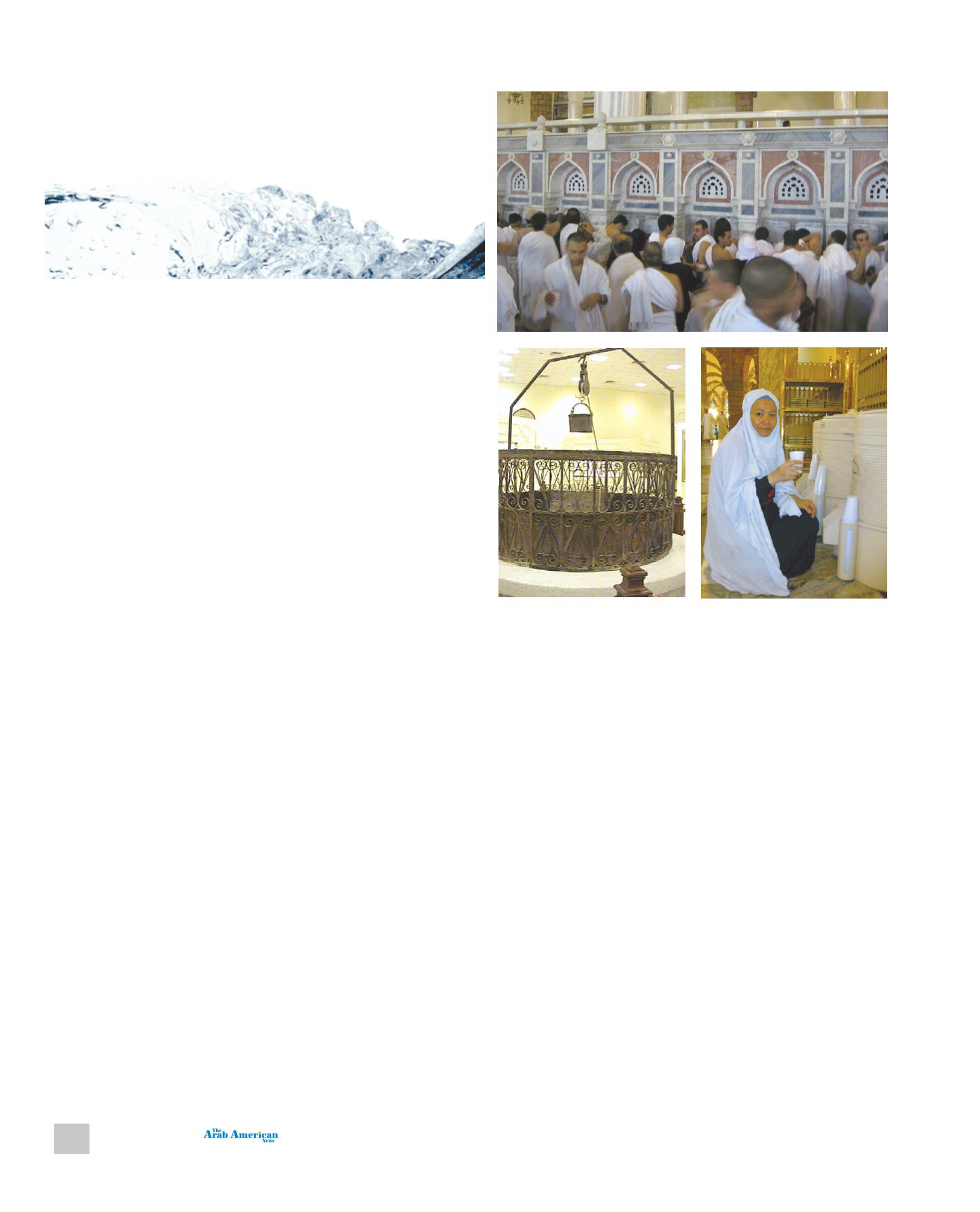
ropes and buckets, but today the well
itself is in a basement room where it
can be seen behind glass panels (visi-
tors are not allowed to enter). Electric
pumps draw the water, which is avail-
able throughout the masjid via water
fountains and dispensing containers
near the Tawaf area.
Hydrogeologically, the well is in the
Wadi Ibrahim (Valley of Abraham).
The upper half of the well is in the
sandy alluvium of the valley, lined with
stone masonry except for the top meter
which has a concrete "collar." The
lower half is in the bedrock. Between
the alluvium and the bedrock is a half-
meter section of permeable weathered
rock, lined with stone, and it is this
section that provides the main water
entry into the well. Water in the well
comes from absorbed rainfall in the
Wadi Ibrahim, as well as run-off from
the local hills. Since the area has be-
come more and more settled, water
from absorbed rainfall on the Wadi
Ibrahim has decreased.
The Saudi Geological Survey has a
"Zamzam Studies and Research Cen-
ter" which analyses the technical prop-
erties of the well in detail. Water levels
were once monitored by hydrograph,
which in more recent times has
changed to a digital monitoring system
that tracks the water level, electric con-
ductivity, pH, Eh, and temperature. All
of this information is made continu-
ously available via the Internet. Other
wells throughout the valley have also
been established, some with digital
recorders, to monitor the response of
the local aquifer system.
The water level is 3.23 meters (about
10.59 ft) below the surface. A pumping
test at 8000 liters/second for more
than a 24 hour period showed a drop in
water level from 3.23 meters below sur-
face to 12.72 meters and then to 13.39
meters, after which the water level
stopped receding. When pumping
stopped, the water level recovered to
3.9 meters below surface only 11 min-
utes later. This data shows that the
aquifer feeding the well seems to
recharge from rock fractures in neigh-
boring mountains around Mecca.
Zamzam water has no color or smell,
but it has a distinct taste, and its pH is
7.9–8.0, indicating that it is alkaline to
some extent.
Sodium chloride (common salt) is in
excess in Zamzam making it taste salty.
Muslims believe that Zamzam is bene-
ficial for health. They also claim that
the excess amount of sodium does not
cause any harmful effects.
The miracle
of Zamzam
Muslims believe the Well of Zamzam is a miracu-
lously generated source of water from God
Top: Pilgrims visit thewell during Hajj. Above left: Zamzamwell in IslamicMu-
seum inMecca. Above right: Pilgrimdrinks Zamzamwater fromcontainer.


