The Arab American News
RAMADAN 2011
18
I
t was just past four the other morn-
ing when Mohammad Boota pulled
his Lincoln Town Car into a service
sta on on an industrial stretch in Long
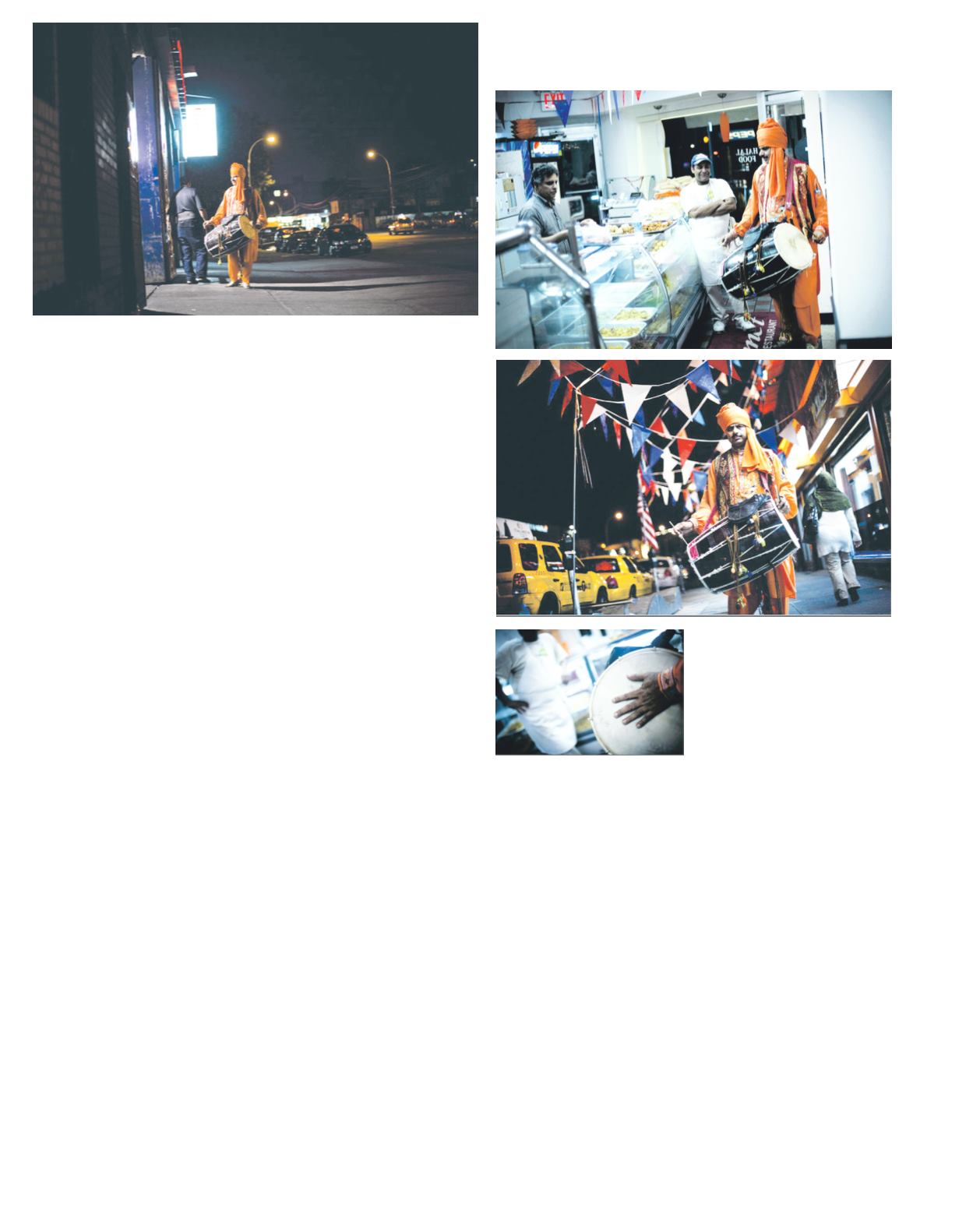
Island City, Queens, and bounded out
— a typhoon of embroidered fabric,
good cheer and unusual urgency.
“I’m late today,” he explained as he
popped the car trunk, hauled out a bar-
rel drum, grabbed two rough-hewn
wooden s cks and, as a few bewildered
mechanics watched, pounded out a
galloping rhythm. The clamor echoed
off a nearby hotel.
Boota, a limousine driver, has built a
sideline as a ceremonial drummer for
his fellow Pakistani immigrants. He is
also New York City’s foremost — and
perhaps only — Ramadan drummer. A
few hours before dawn during the holy
month of Ramadan, drummers
throughout the Muslim world take to
the streets to wake the faithful in me
for a meal before the day me fast.
Boota, 54, introduced the ritual to
the darkened streets of Brooklyn
about eight years ago. But a er his
drumming roused a spate of noise
complaints, he restricted himself to a
few blocks along Coney Island Avenue,
where many Muslims live. This year,
however, he has decided to push back
— gently. Ramadan began on Aug. 11
and ends on Thursday, and on this re-
cent morning Mr. Boota was taking the
tradi on farther afield, pioneering
new drumming territory in Queens.
His plan was cau ous. He intended
to play only in front of Pakistani-owned
businesses — gas sta ons, corner
stores, restaurants — and never as
loudly as he might were he in, say, Is-
lamabad or Karachi.
“I’m not going to play where people
have a problem,” he said, wearing a
shimmering orange shalwar kameez —
a tradi onal two-piece ou it — and a
matching turban. “We, the Muslim
people, already have so many issues.”
“I want people happy, dancing, eat-
ing,” he added. “I want to keep every-
body happy.”
He was responding to demand, he
explained. Since The New York Times
published an ar cle about him last year,
Pakistanis and other Muslims have
asked him to come play on their blocks.
“They say, ‘Why don’t you come to
our place, too?’ ” said Boota, who im-
migrated in 1992 and lives with his wife
and eight children in Coney Island.
“They want me. Everybody happy!”
But now me was of the essence:
Only about half an hour remained be-
fore everyone would already be up and
heading to morning prayer. In the his-
tory of Ramadan, countless drummers
have been stayed from their rounds by
war, flood and pes lence, but probably
none by early-morning e-ups on the
Brooklyn-Queens Expressway.
As Boota hammered at his drum in
the service sta on, a Pakistani me-
chanic whooped, pulled out a cell-
phone and began dancing a jerky,
head-wobbling two-step, holding his
phone alo , relaying the performance
to a friend at the other end of the line.
Less than a minute later, however,
Boota abruptly stopped. “Ready to
go?” he asked, before jumping into his
car.
Several blocks north, he pulled into
another service sta on, Punjab Auto
Repair, also Pakistani-owned. Same
drill.
As he plastered the walls of the me-
chanic’s bay with percussive sound,
Imran, the manager, said Boota was
maintaining an important custom, even
if its usefulness had been eclipsed long
ago by the alarm clock.
“It’s Pakistani culture,” said Imran,
who gave only his first name. Then he
nodded at Boota. “He’s a very famous
guy,” he said, proudly.
Suddenly, Boota was back in his car.
“Thank you, mister,” he called out the
window to a mechanic. “God bless you,
Monday-to-Friday guy!” And in short
order, he had driven several more
blocks north, played inside a nearly
empty Pakistani restaurant in Astoria,
and was barreling southeast on the
B.Q.E. toward Jackson Heights.
Even though the debate over a
planned Islamic center near Ground
Zero has made some Muslims in New
York fearful of calling a en on to
themselves, Boota never considered
suspending his street drumming.
“This is America — America has a
Cons tu on, freedom of religion,” he
said. “We’re not doing anything
wrong.” He blamed poli cians for in-
flaming the issue. “The poli cal people
are just trying to make the big smoke,”
he said.
Arriving in Jackson Heights, he
parked on Broadway, where two large
Pakistani restaurants face each other
from opposite sides of the street. Ex-
cept for twomen drinking coffee on the
sidewalk, the block was empty. Boota
sha ered the quiet.
“What is this?” one man asked. “Is
this somebody’s birthday?”
Several others came to the windows
of Gourmet Sweets and Restaurant. The
owner teased himabout arriving so late.
“Time is gone,” Boota sighed, step-
ping inside the restaurant and playing
briefly.
“It’s like my big family,” he said, then
sat down for a cup of tea.
This ar cle was originally published in
The New York Times, September 5,
2010.
A Ramadan drumbeat
is sounded in Queens
“I want people
happy, dancing,
eating. I want to
keep everybody
happy.”


