The Arab American News
RAMADAN 2011
10
By Azadeh Moaveni
TIME
F
or Muslim immigrants in the U.S., the days fol-
lowing 9/11 were a harrowing encounter with
American hate. iPod-bearing, second-genera-
on techies faced insults in Silicon Valley parking
lots; schoolgirls in headscarves were a acked;
mosques across the country were vandalized. For
many months, it seemed unclear whether America's
Muslims — from the cocktail-swilling secular to the
mosque-a ending pious — would ever live again
without apprehension.
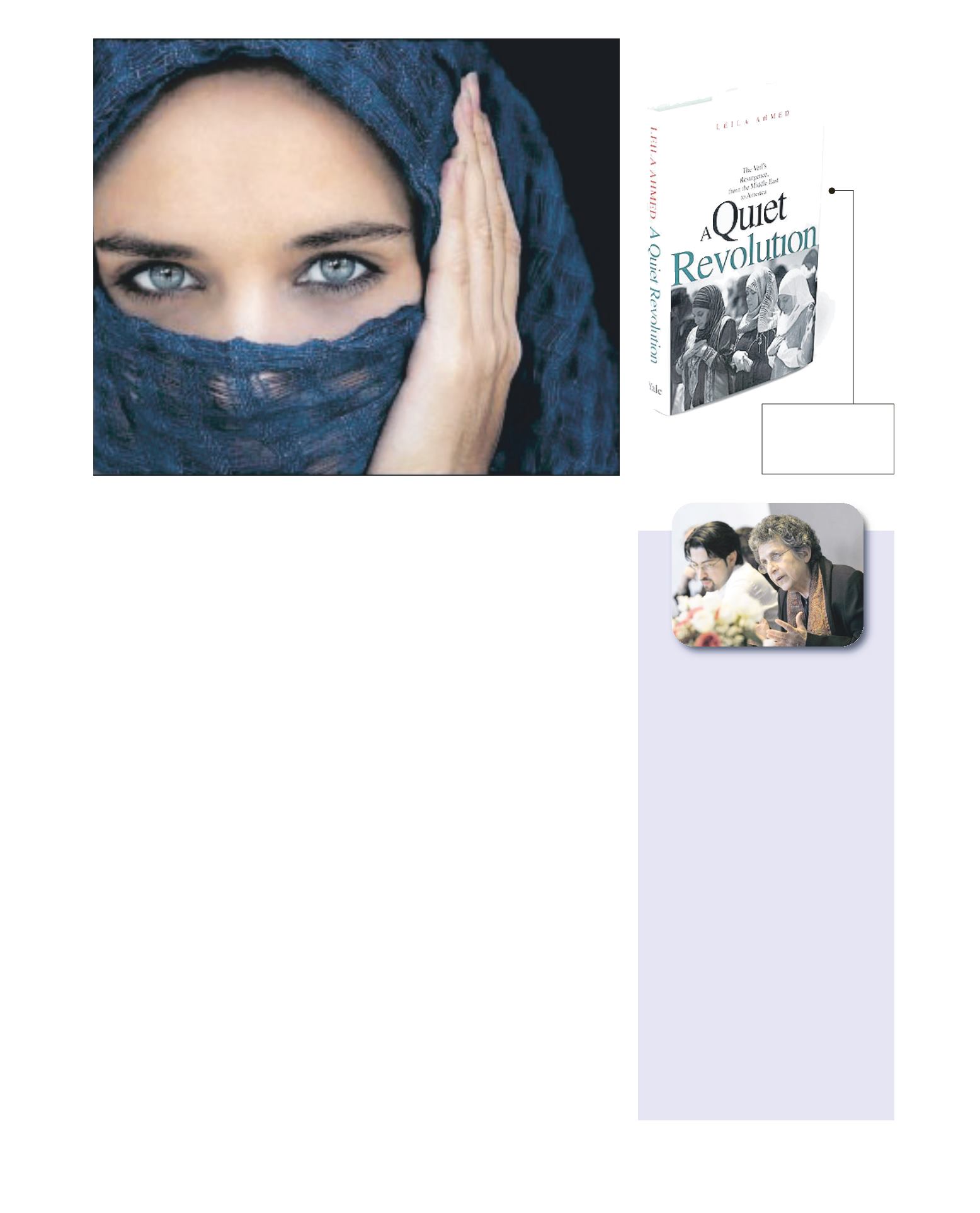
That period, Harvard academic Leila Ahmed ar-
gues in a new book, turns out to have been a very
good thing. Its long-term effect has been to remake
American Islam, making the country's most conser-
va ve Muslims tolerant of cri cism and open to a
young genera on's more liberal demands. The re-
sult, Ahmed writes in "A Quiet Revolu on," is no less
than a new moment "in the history of Islam as well
as of America."
She arrives at this conclusion by way of tracing
the history of the veil. The bareheaded women of
Ahmed's Cairo girlhood considered veiling an out-
moded habit of a repressive past, but by the early
1990s many Muslim women around the world were
again covering up, and Ahmed sets out to under-
stand why.
The story behind the veil's resurgence is not
straigh orward: everything plays a role, from Bri sh
colonialism and the rise of Islamism to Egypt's scle-
ro c economy, Arab enmity with Israel and Saudi
money. What Ahmed wants us to understand is that
the veil has gone through the wash cycle of history
and that its meaning today is both fresh and local. It
is no longer a bandanna version of the all-envelop-
ing burqa, signaling a woman's brainwashed sub-
missiveness. Today, Ahmed argues, the veil o en
reflects a tudes that have li le to do with piety.
Many women in post-9/11 America, she notes,
began wearing it to protest discrimina on against
Muslims.
The portrait of post-9/11 Muslim America that
Ahmed offers up bolsters her case for this new era's
promise. There are the campaigns to move the
women's sec ons of mosques out of basements, the
feminist transla on of the Qur'an and the accounts
of conven ons where Muslim authori es offer cri cs
a pla orm to lambast their faith. Even if Muslim eld-
ers are merely pu ng up a facade of liberality to
ward off poli cal a ack, Ahmed concludes, the cli-
mate is shaping a new genera on of Muslims who
demand more progressive ways.
Many, of course, will be skep cal when it comes
to Ahmed's rosy asser on that the veil's resurgence
dovetails with a feminist, ac vist spirit. Some will
ques on whether it even makes sense to discuss the
veil so sweepingly when the climates in which
women wear it — from Connec cut to Karachi —
vary so drama cally. And feminists will rebuke
Ahmed for trying to honey-coat a covering that to
them will always symbolize Islam's patriarchy.
Of course, the veil has a remarkable ability to pro-
voke impassioned arguments on many issues be-
sides gender poli cs, from the success or failure of
mul culturalism to secularism in educa on.
Ahmed's book will doubtlessly con nue the debate.
But laced into her historical account of the veil are
gems of insight. Saudi Arabia's shadow looms long
across the book, and the kingdom emerges as the
victor in the veil's resurgence, its long me project to
export Wahhabi Islam's stricter ways a global suc-
cess. Most striking of all, we learn that conserva ve
Muslims, and veiled Muslims, make up a decided mi-
nority in America. The rest are living discreet lives —
either secular or private in their prac ce of Islam —
a silent majority receiving no one's a en on.
Leila Ahmed, born in 1940, is an Egyp an Ameri-
can writer on Islam and Islamic feminism as well
as being the first women's studies professor at
Harvard Divinity School.
Born in the Heliopolis district of Cairo to a mid-
dle-class Egyp an father and an upper class Turk-
ish mother in 1940, Ahmed's childhood was
shaped both by Muslim Egyp an values and the
liberal orienta on of Egypt's aristocracy under the
ancient régime. A er Egypt's last ruling monarch
was overthrown by the Free Officers Movement in
1952, life for Ahmed's family along with others in
her milieu was irrevocably changed. Her father, a
civil engineer, was a strong opponent of Gamal
Abdel Nasser's construc on of the Aswan High
Dam on ecological principles. This earned him the
wrath of the ruling regime for years to follow and
had detrimental effects on the family.
She earned her doctorate degree from Univer-
sity of Cambridge during the 1960s before moving
to the United States to teach and write, where she
was appointed to professorship in Women’s Stud-
ies and Near Eastern studies at the University of
Massachuse s Amherst in 1981 followed by a pro-
fessorship in Women's Studies and Religion at the
Harvard Divinity School in 1999, where she cur-
rently teaches.
The fabric of a culture
Harvard academic
Leila Ahmed
A Quiet Revolu on
The Veil's Resurgence, from
the Middle East to America.
Yale University Press, 2011,
352 pages
.


