11
RAMADAN 2011
The Arab American News
By Bethsaida Nieves
Middle East Online
W
hat does it mean to be a
Muslim woman in America
today? In "I Speak for My-
self," 40 Muslim American women
share their experiences of growing up
in America. Their personal narra ves
of struggles and triumphs remind us
that we share much more in the jour-
ney of life than we o en realize.
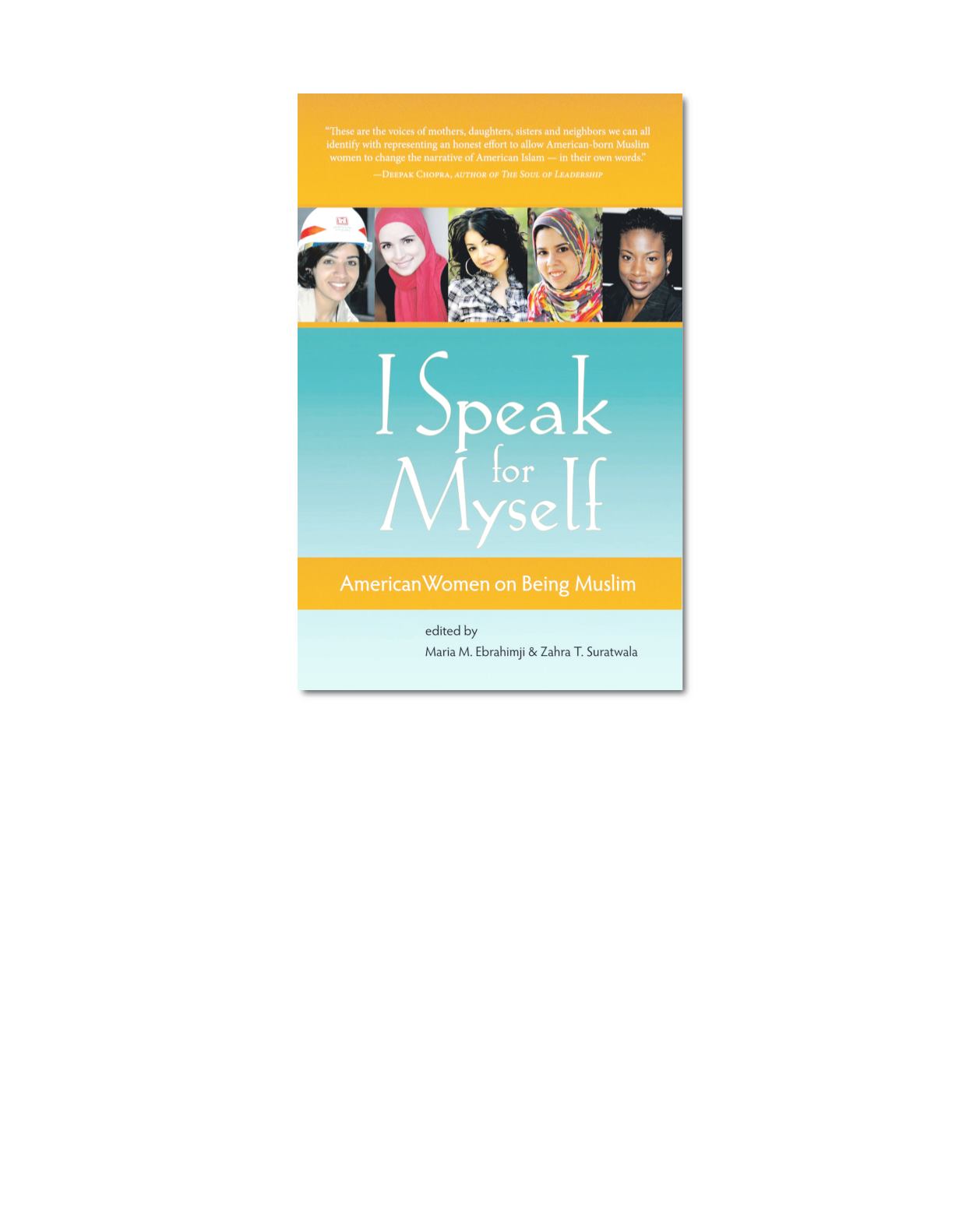
"I Speak for Myself: American
Women on Being Muslim," edited by
Maria M. Ebrahimji and Zahra T. Surat-
wala, engages readers in a complex set
of emo onal, symbolic and social con-
sidera ons related to growing up as a
Muslim woman in America.
The stories are a manifesta on of
the spiritual evolu on of change. On
the surface, we read of problema c
rela onships with husbands, co-work-
ers, parents and friends but, on a
deeper level, the journey is an expres-
sion of the human spirit. These
women triumph over adversity in their
lives and remind us of the poten al
and courage within each of us. As we
mature and evolve, we come to de-
velop an awareness of the beauty and
sacredness of life that transcends cul-
ture. For example, one woman writes
about finding the strength and power
of her voice a er divorce and abuse.
Another woman discusses the cultural
significance of her conversa ons while
working for a state representa ve.
We also read of how one woman
humorously and anxiously deals with
the genera onal and cultural gaps she
experiences with her parents. Grap-
pling with the desire to fit in, another
woman describes how she struggles to
explain and ra onalize her name,
while yet another speaks to the diffi-
culty in deciding whether or not to
wear the hijab (headscarf). Each
woman describes her own deepest
crea ve poten al, and expresses pro-
found truths about human existence.
Set in the United States and several
countries around the world, "I Speak
for Myself" is contextualised within
the discourses of American and Mus-
lim iden es. This collec on of stories
extends these discourses into issues of
race, class, religion, ethnicity, history,
poli cs, language and gender. They
complicate each society’s no ons of
history, Islam and culture, which ul -
mately challenges the idea that Mus-
lim women are voiceless and
powerless. These authors teach us
that beyond culture, there is a deeper
e that binds us – our desire for peace
and social jus ce.
"I Speak for Myself" provides para-
digms that illuminate human possibil-
i es. Each woman describes an Amer-
ican iden ty plagued by real ambiva-
lence and anxiety about the obvious
interconnectedness between religion,
poli cs and societal expecta ons. One
woman speaks of a childhood friend
who viewed her as American and not
Muslim and how, at the me, it almost
made her proud. But the confusion
made her pause and realize that she
did not have to choose between being
Muslim and being American. She
could be both.
Another woman explains how in
her youth she struggled with being the
“right” type of Muslim and fi ng in
the Muslim community. She soon rec-
ognized that there was not only one
way to be Muslim and that Islam wel-
comed a wide range of religious ex-
pression.
But the challenges were not only in
childhood or adolescence. An African
American Muslim woman describes
how she feels both included and ex-
cluded within the Muslim community,
and her desire for Muslims to address
discrimina on within some Muslim
communi es. Another African Ameri-
can woman describes the frustra on
she experienced when she tried to ad-
here to a “true” Islamic, feminist and
African American iden ty. Instead, she
decides to embrace the fragmented
and contradictory parts of her individ-
uality, rather than try to be like every-
one else.
The discussion of each woman’s re-
ligious beliefs reflects how iden es
fluctuate and are appropriated and
nego ated. Each woman becomes
part of this complex nego a on of
power and powerlessness in which
she undercuts the mythology of the
oppressed Muslimwoman and creates
a model of resistance.
The women who have shared their
stories are engineers, doctors,
lawyers, community leaders, social
jus ce advocates, former Peace Corps
and Teach for America volunteers,
ar sts, professors, students, poli -
cians, award winners, bloggers, jour-
nalists, environmentalists and, above
all, our sisters in humanity. Through
the experiences of each woman, read-
ers of "I Speak for Myself" a ain a
stronger level of understanding of
what it means to grow up as a Muslim
woman in America.
Bethsaida Nieves is a doctoral student
at the University of Wisconsin-Madi-
son. Her research and teaching inter-
ests include compara ve and
interna onal educa on studies. This
ar cle was wri en for the Common
Ground News Service (CGNews).
The many faces of
Muslim American women
In "I Speak for Myself," 40 Muslim American women share
their experiences of growing up in America.
These women triumph over
adversity in their lives
and remind us of the po-
tential and courage within
each of us. As we mature
and evolve, we come to de-
velop an awareness of the
beauty and sacredness of
life that transcends cul-
ture. For example, one
woman writes about find-
ing the strength and power
of her voice after divorce
and abuse. Another woman
discusses the cultural sig-
nificance of her conversa-
tions while working for a
state representative.


