The Arab American News
RAMADAN 2011
6
By Lisa Kaaki
T
alk of shari'a is gaining momen-
tum as an increasing number of
Muslims are living in Western so-
cie es. Despite its mul cultural soci-
ety, the United States is the least
accommoda ng toward its Muslim
popula on. England, on the contrary,
by accep ng the presence of Muslim
schools, chari es, banks and Islamic ar-
bitra on tribunals, has been the least
biased toward its Muslim ci zens. As a
result, Muslims in the UK are increas-
ingly turning to Islamic courts, mainly to
resolve family disputes.
Back in 2006, a study revealed that 85
unofficial shari'a courts were already op-
era ng out of mosques all over the
United Kingdom. The largest of them, the
Islamic Shari'a Council in Leyton, set up in
1982, has handled 7,000 divorce cases.
Mu i Barkatullah, one of its founders ex-
plains:
"People who live in the United Kingdom
undertake and abide by the law of the land,
but they regard those laws as administra-
ve laws, not a divine law. The ma ers of
marriage and divorce don't fall into the state
domain. They are religious ma ers."
The first Muslim Arbitra on Tribunal, the
first official shari'a law court in the UK, was
set up in December 2007 by scholars and
lawyers at Hijaz College Islamic University in
Nuneaton, Warwickshire. The Muslim Arbi-
tra on Tribunal has binding legal status be-
cause it operates in tandem with the Bri sh legal
system and decisions challenged by the losing party
will be upheld by a county court bailiff or high court
sheriff.
The advances made by Islamic law into Britain hit
the headlines when in February 2008, the Arch-
bishop of Canterbury, Dr. Rowan Williams, said in a
public lecture at the Royal Courts of Jus ce: "... my
aim is only… to tease out some of the broader issues
around the rights of religious groups within a secu-
lar state, with a few thoughts about what might be
entailed in cra ing a just and construc ve rela on-
ship between Islamic law and the statutory law of
the United Kingdom."
These comments caused a firestorm and more
than 250 ar cles appeared in the world press within
a month. The polarized debate that followed trig-
gered the idea for this book, which explores the con-
flict between Western secularism and the demands
of Islam as well as the issues of equality before the
law and parallel jurisdic ons in a mul cultural soci-
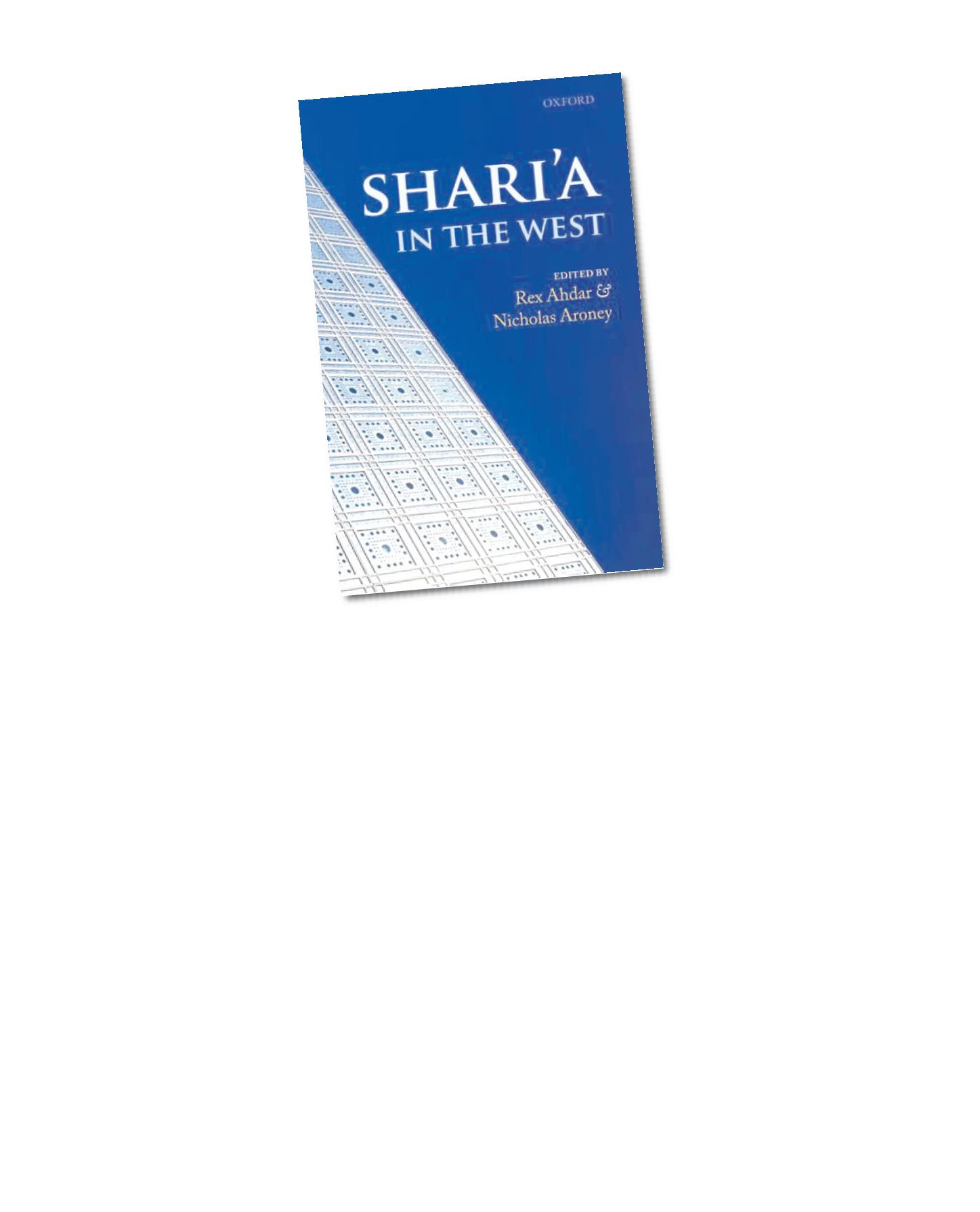
ety. "Shari’a in the West" is a collec on of essays by
leading scholars represen ng different poli cal
viewpoints and faith tradi ons.
In their introduc on, the editors, Rex Ahdar and
Nicholas Aroney, admit that the ques on of whether
shari'a should be recognized and incorporated into
the legal systems of the liberal democracies of the
West is an imposing one: "The issue has become a
proverbial 'hot potato' in the corridors of power, as
well as the more commonplace cafes, cyberspace
chat rooms, bars, and living rooms of society. Hardly
a week goes by in the West without a controversy
erup ng over some aspects of Muslim ritual, sym-
bolism, belief or prac ce."
On the one hand, cri cs fear that secularism, lib-
eralism and individualism in Western democracies
are under threat because the shari'a involves all the
aspects of our life from the in mately personal, spir-
itual and familial, through to the management of in-
terpersonal rela ons at a communal level. Shari'a is
also feared in the West where it conjures up images
of harsh physical punishments. On the other hand
members of non-Chris an faiths invoke the princi-
ples of Western liberalism supposed to grant the
right to freely prac ce different religions.
Wael Hallaq (quoted by Rex Ahdar and Nicholas
Aroney) makes an interes ng point when he says
that the Western coloniza on of the Islamic
world during the 19th and early 20th centuries
led to the crea on of "sovereign" na on-states
and the enactment of posi ve legal codes em-
bodying secular legal values. This resulted in
the severing of the ins tu onal and social roots
of the old shari'a-based rule of law which in
me resulted in a fundamentalist resurgence
with an emphasis on the reins tu on of Is-
lamic law.
"The Future of Muslim Family Law in West-
ern Democracies," one of the best essays in
the book, is wri en by John Wi e, a leading
specialist in legal history, marriage law and
religious liberty. Director of Emory Univer-
sity's outstanding Centre for the Study of
Law and Religion, Professor Wi e warns
shari'a advocates that it takes me and pa-
ence for a secular legal system to adjust to
the reali es and needs of new religious
groups and to make the necessary legal ac-
commoda ons. It also takes flexibility and
innova on for a religious community to
win accommoda on from secular laws.
"Over me, and only grudgingly, West-
ern democracies learned to accommo-
date the core religious beliefs and
prac ces of Jewish communi es. Dias-
pora Muslim communi es in the West
need to do the same," writes John Wi e
who also invites Muslims to tolerate the core values
of their secular host na ons, if they are hoping to
get concessions for their religious courts and other
religious prac ces. And finally, he believes that Mus-
lim tribunals must be more legally sophis cated and
procedurally equitable to a ract voluntary Muslim
disputants and to be acceptable to secular state
courts.
"Like the Jewish 'beth din’' that sits in New York or
London, the Muslim law court needs to be staffed
by jurists who are well trained both in Muslim law
and in secular law. It is much harder for a court to
have such suspicions when educated Muslim par-
es, eyes wide open, choose a legally sophis cated
Muslim arbitra on tribunal over a secular court that
does not share their core values but s ll offers a se-
rious jurispruden al op on for them to state mar-
riage law."
Despite its complexity, the issue of the rela on-
ship between shari'a and Western legal systems is
of prime interest to policymakers, jurists and Mus-
lims living in the West. To what extent a liberal state
will accommodate the Islamic faith depends very
much on the exis ng legal framework of that coun-
try. However, any accommoda on is seen as a con-
cession granted by the provisions of a law for all
ci zens and not as an acknowledgment of a legal
system set up for ci zens of minority faiths.
"Shari'a in the West" opens the path for lively dis-
cussions on the place of Islam in the Western, mul-
cultural democracies. It also raises the point made
by Tariq Ramadan that shari'a is o en interpreted in
ways inconsistent with its core principles and it
needs serious scholarly reform and consensual mod-
erniza on.
Shari'a in the West
Edited by Rex Ahdar and Nicholas Aroney
352 pages | Hardback | 16 December 2010
Time and
patience
Despite its complexity, the issue of
the rela onship between shari'a
and Western legal systems is of prime
interest to policymakers, jurists and
Muslims living in the West. To
what extent a liberal state will
accommodate the Islamic faith
depends very much on the exis ng
legal framework of that country.


