Ramadan
20
10
20
I
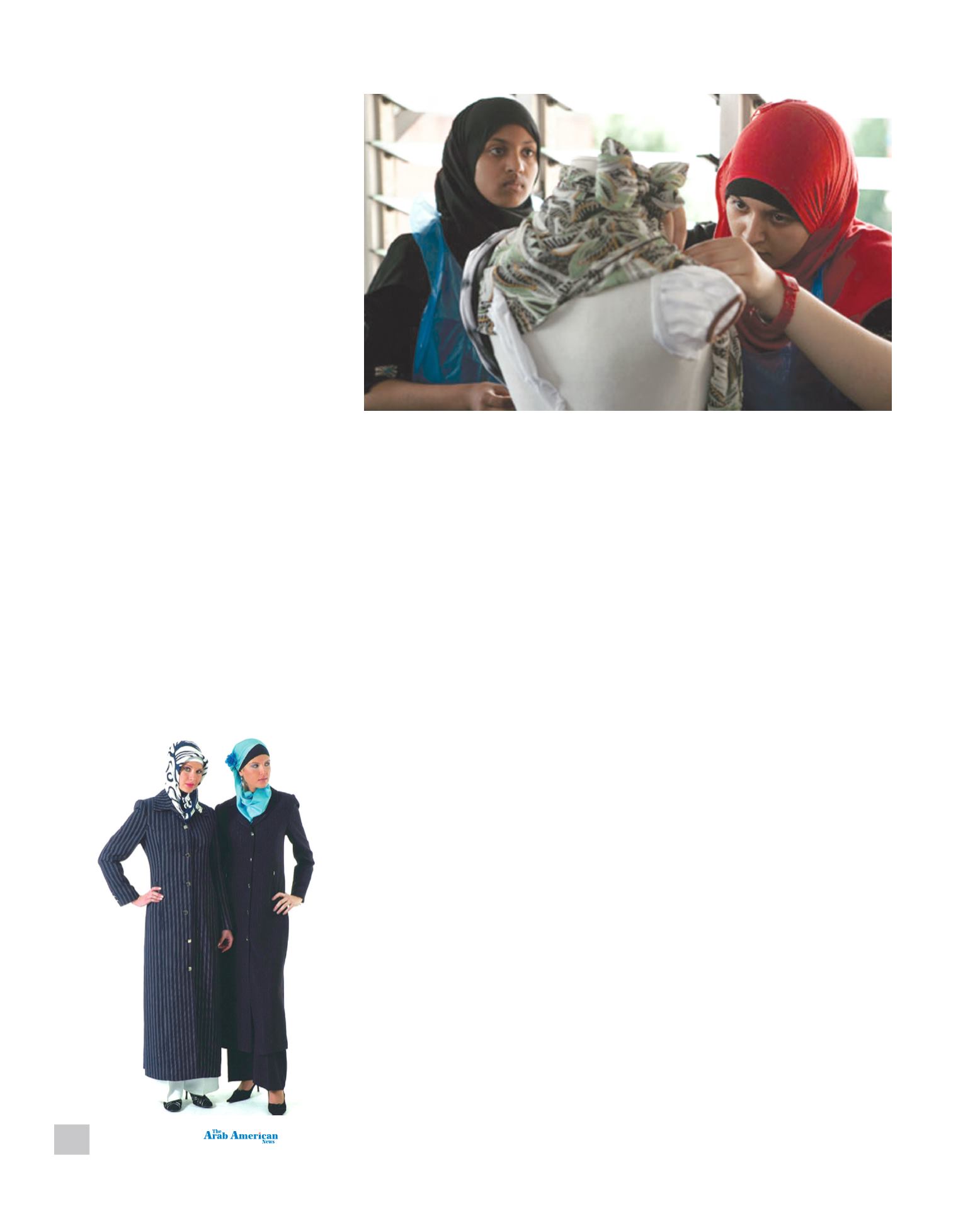
n a first floor classroom in the Hackney cam-
pus of the London School of Fashion a small
group of young schoolgirls are wrapping
clothes on to tailor's dummies.
They are using conventional clothes in un-
conventional ways – turning ties into belts and
baggy T-shirts into neckwear. The idea is to
challenge traditional notions of normality in
fashion.
The approach is a common one for aspiring
designers but it feels especially appropriate for
the 20 assembled schoolgirls, all of whom are
British and Muslim and all of whom are in tradi-
tional Islamic dress.
The girls are taking part in an initiative called
Faith and Fashion that is using the widespread
fixation of Muslim women's dress as a starting
point for a discussion on how to create fashion
that reflects a British Muslim sensibility. Sophia
Tillie, the 28-year-old white, British woman who
runs the scheme, converted to Islam while at
university. She is now engaged in trying to ex-
amine how the concept of modesty – so essen-
tial to Islamic thinking – can be interpreted
differently depending on the context of time
and place.
"The Saudi tradition of wearing the niqab is
very literalist," she explains, "and it is part of a
puritanical movement that is reductionist in its
doctrine. But reading more widely I was struck
by the flexibility of Islamic thinking and that
was what this initiative seeks to encourage."
The scheme is backed by the Three Faiths
Forum, an interfaith organisation that works at
grassroots to support harmony and confront
prejudice between different religious communi-
ties.
For Tillie the media obsession with the burqa
obscures the richly diverse ways that Muslims
throughout the centuries have chosen to dress.
"Banning the burqa will send it underground
and oppress further the women who are still
perceiving it as the only way to dress to be a fully
observant Muslim. The reason I set up Faith and
Fashion was to create a safe space where we
could look at why some Muslim women have
chosen to interpret some verses of the Koran to
support the burqa and by opening up that space
that allows opportunities for other choices and
other interpretations."
Among the girls who are busy wrapping a pale
blue pair of trousers around the neck of the
mannequin is 15-year-old Tasnem. "I've always
been really interested in fashion," she says. "I
like stuff that is funky, if I was wearing a hijab I
would like to wear a massive bow with it."
The girls are all competition winners having
beaten more than 100 other girls by producing
portfolios which featured drawings of clothes
they had designed which expressed their British
and Muslim identities. The girls all attend Is-
lamic schools in different parts of London and
some of their portfolios included poetic expla-
nations of their decision to wear the hijab.
"Allah doesn't look for our outer but our inner
beauty," reads one verse. "Men walking down
the street, 'Oh she's a cutie'/Women wear the
hijab for protection/Not for affection/We have
education/And we want an occupation."
For the young women involved there is no
contradiction between being interested in fash-
ion and being observant Muslims. Says Nadaya:
"I was on the bus and someone asked me why I
was wearing a hijab – it frustrates me because
they don't know anything about me and yet they
are judging me."
Another of the young women, Musafa, 15, was
dressed in a full veil that obscured everything
except her eyes. She was also wearing an electric
green jacket. "I like to dress nicely and I like to
express myself through clothing," she says.
"People think that I must be forced to wear this
but I came to the decision on my own and be-
cause all my five sisters and my mother wear it."
During the three days that they are at the
London College of Fashion they will develop de-
sign and IT skills and well as being given advice
by design experts. It is the sort of training that
they would usually never have the chance to re-
ceive in their Islamic schools.
"The great thing about this course is that the
girls are learning that dressing modestly does
not have to be boring," says Hassaanah, a
teacher in an Islamic school in Tooting Bec.
"We do study aspects of identity at our school
but the aspect of understanding other religions
and their history of modesty has been new."
By the end of the afternoon the three tailor's
dummies stood in their new outfits. "This was
my chance to really be creative," said Tasnem
proudly. "It was so great to be able to meet other
Muslim girls who were also into fashion."
— guardian.co.uk
Muslim schoolgirls dress a dummy at the Faith and Fashion workshop. Photograph: Mark Tillie
Muslim schoolgirls show
that faith and fashion are
not incompatible
Students gave traditional dress a makeover after winning places
for an Islamic fashion course


