Ramadan
20
10
22
T
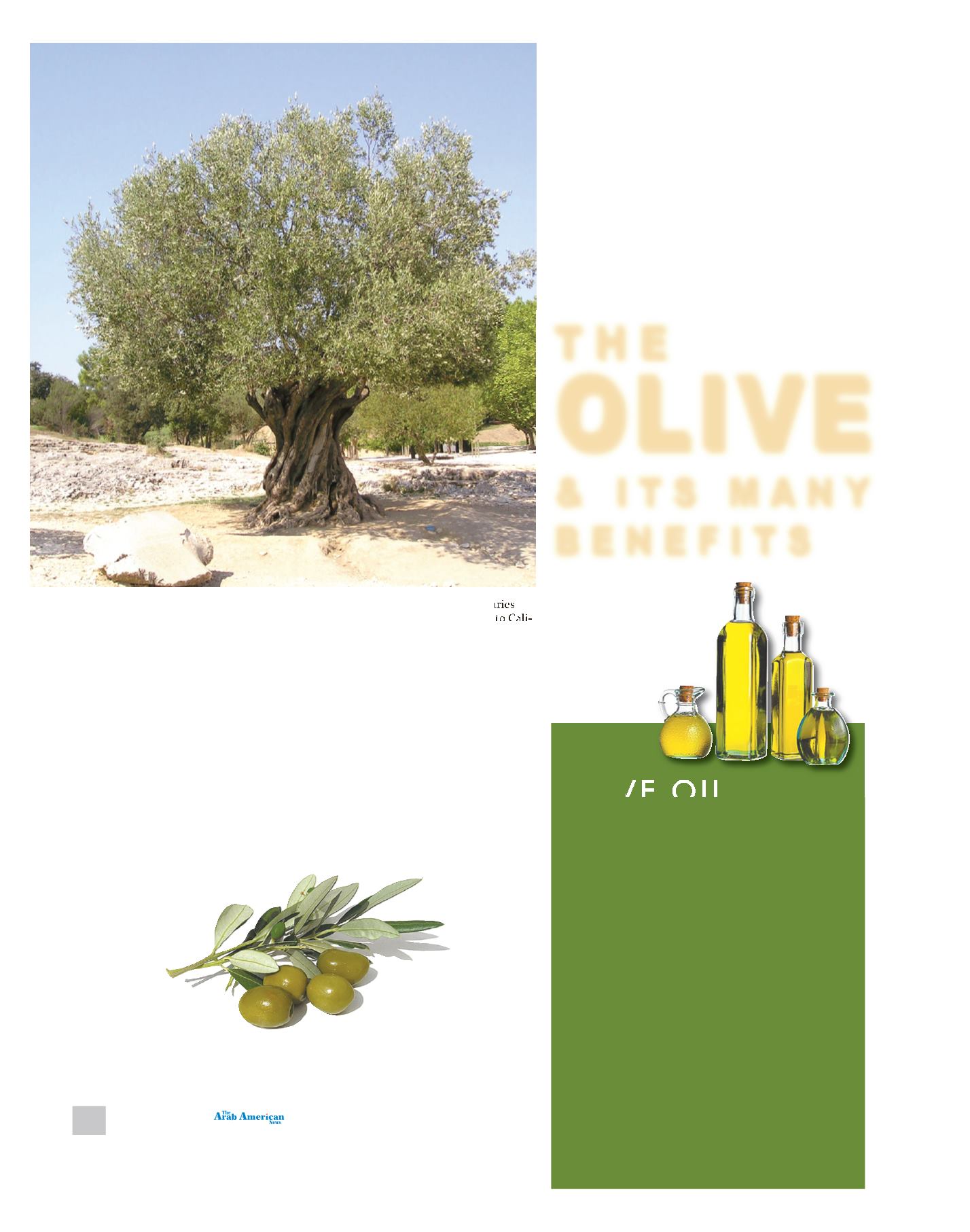
he olive was native to Asia Minor
and spread from Iran, Syria and
Palestine to the rest of the Mediter-
ranean basin 6,000 years ago. It is among
the oldest known cultivated trees in the
world - being grown before the written
language was invented. It was being
grown on Crete by 3,000 BC and may
have been the source of the wealth of the
Minoan kingdom. The Phoenicians
spread the olive to the Mediterranean
shores of Africa and Southern Europe.
Olives have been found in Egyptian
tombs from 2,000 years BC. The olive
culture was spread to the early Greeks
then Romans. As the Romans extended
their domain they brought the olive with
them.
1,400 years ago the Prophet of Islam,
Muhammad, advised his followers to
apply olive oil to their bodies, and
himself used oil on
his head. The use of
oil is found in
many religions and
cultures. It
has been
used dur-
ing special cer-
emonies as well as a
general health measure.
During baptism in the Christian church,
holy oil, which is often olive oil, may be
used for anointment. At the Christmas
mass, olive oil blessed by the bishop,
"chrism", is used in the ceremony. Like
the grape, the Christian missionaries
brought the olive tree with them to Cali-
fornia for food but also for ceremonial
use. Olive oil was used to anoint the early
kings of the Greeks and Jews. The Greeks
anointed winning athletes. Olive oil has
also been used to anoint the dead in
many cultures.
The olive trees on the Mount of Olives
in Jerusalem are reputed to be over 2000
years old, still relative newcomers con-
sidering the long domestication of the
olive. We don't know the exact variety of
the trees on the Mount. Man has manip-
ulated the olive tree for so many thou-
sands of years that it is unclear what
varieties came from which other vari-
eties. Varieties in one country have been
found to be identical to differently
named varieties in
another. Some re-
search is now being
done using gene
mapping tech-
niques to fig-
ure out the
olive family tree.
Shrub-like "feral" olives still
exist in the Middle East and rep-
resent the original stock from
which all other
olives are descended.
In the past several hundred years the
olive has spread to North and South
America, Japan, New Zealand and Aus-
tralia.
Allah is the Light of the heavens and the earth.
The metaphor of His Light is that of a niche in
which is a lamp, the lamp inside a glass, the glass
like a brilliant star, lit from a blessed tree, an olive,
neither of the east nor of the west, its oil all but
giving off light even if no fire touches it. Light upon
Light. Allah guides to His Light whoever He wills
and Allah makes metaphors for mankind and
Allah has knowledge of all things.
(Qur'an, 24:35)
OL IVE OI L . . .
When choosing fats, olive oil is a healthy choice. Olive oil
contains monounsaturated fat, a healthier type of fat that
can lower your risk of heart disease by reducing the total
and low-density lipoprotein (LDL, or "bad") cholesterol lev-
els in your blood.
In contrast, saturated and trans fats — such as butter, an-
imal fats, tropical oils and partially hydrogenated oils — in-
crease your risk of heart disease by increasing your total
and LDL cholesterol levels.
According to the Food and Drug Administration (FDA),
consuming about 2 tablespoons (23 grams) of olive oil a
day may reduce your risk of heart disease. You can get
the most benefit by substituting olive oil for saturated fats
rather than just adding more olive oil to your diet.
All types of olive oil contain monounsaturated fat, but
"extra-virgin" or "virgin" olive oils are the least processed
forms, so they're the most heart healthy. Those types con-
tain the highest levels of polyphenols, a powerful antioxi-
dant that also can promote heart health.
From the Mayo Clinic
T H E
OLIVE
& I T S M A N Y
B E N E F I T S


