By John L. Esposito and
Dalia Mogahed
I
n sharp contrast to the popular
image of silent submissiveness,
Gallup findings on women in
countries that are predominantly
Muslim or have sizable Muslim pop-
ulations hardly show that they have
been conditioned to accept second-
class status. Majorities of women in
virtually every country we surveyed
say that women deserve the same
legal rights as men, to vote without
influence from family members, to
work at any job they are qualified
for, and even to serve in the highest
levels of government. In Saudi Ara-
bia, for example, where as of this
writing, women were not allowed to
vote or drive, majorities of women
say that women should be able to
drive a car by themselves (61%), vote
without influence (69%), and work
at any job for which they are quali-
fied (76%). Egyptian women, who
have faced far fewer restrictions
than their Saudi counterparts, speak
even more strongly in favor of
women's rights, with 88% of Egypt-
ian women saying that they should
be allowed to work at any job for
which they are qualified. In Egypt,
as in other parts of the Muslim
world, this attitude is not just a the-
ory, as a full third of professional
and technical workers in Egypt are
women, on par with Turkey and
South Korea.
If you want to put faces to these
data, observe women such as Souad
Saleh, an assertive and outspoken
woman whose area of expertise is
fiqh, or Islamic jurisprudence. Saleh
is an Islamic jurist and professor at
al-Azhar University, the most
prominent institution of Islamic
scholarship and authority in Sunni
Islam. She was the first woman dean
of faculty at the institution and is a
prolific writer on issues ranging
from family law to women's rights,
authoring more than seven volumes
on Islam and at least four in-depth
research works. A regular on pan-
Arab television and one of the most
outspoken preachers on Islam, her
message is clear: "Islam is simple
and holds women in high esteem."
Celebrity preachers aren't the
only ones who defy conventional
wisdom. There are also women like
Salwa Riffat, an Egyptian woman
now in her late 50s who earned her
bachelor's degree in aeronautical
engineering from Cairo University
and went on to earn her Ph.D. in
civil engineering. At the same time,
she managed to successfully balance
raising a family and fulfilling the de-
mands of her career. She is now a
professor of engineering, teaching
men and women alike. "Women of
my generation were at the forefront
of a new era in Egypt," she
says, referring to the wave of women
attending college that gained mo-
mentum in the 1950s and 1960s.
"Now, it's hardly something worth
noting that in Egypt, universities are
filled with women, in some cases
more than men, and they are ex-
celling." The valedictorians of
Cairo's elite medical school are fa-
mously known to almost always be
female.
These cases are hardly unique.
Nationally representative self re-
ported data show percentages of
women in Iran (52%), Egypt (34%),
Saudi Arabia (32%), and Lebanon
(37%) with postsecondary educa-
tions. In the United Arab Emirates
and Iran, women make up the ma-
jority of university stu-
dents. However, in Muslim coun-
tries -- as well as in non-Muslim
countries -- Gallup finds a wide
range of female education with per-
centages of women pursuing post-
secondary educations dipping as
low as 8% and 13% in Morocco and
Pakistan, respectively, which is com-
parable with 4% in Brazil, or 11% in
the Czech Republic.
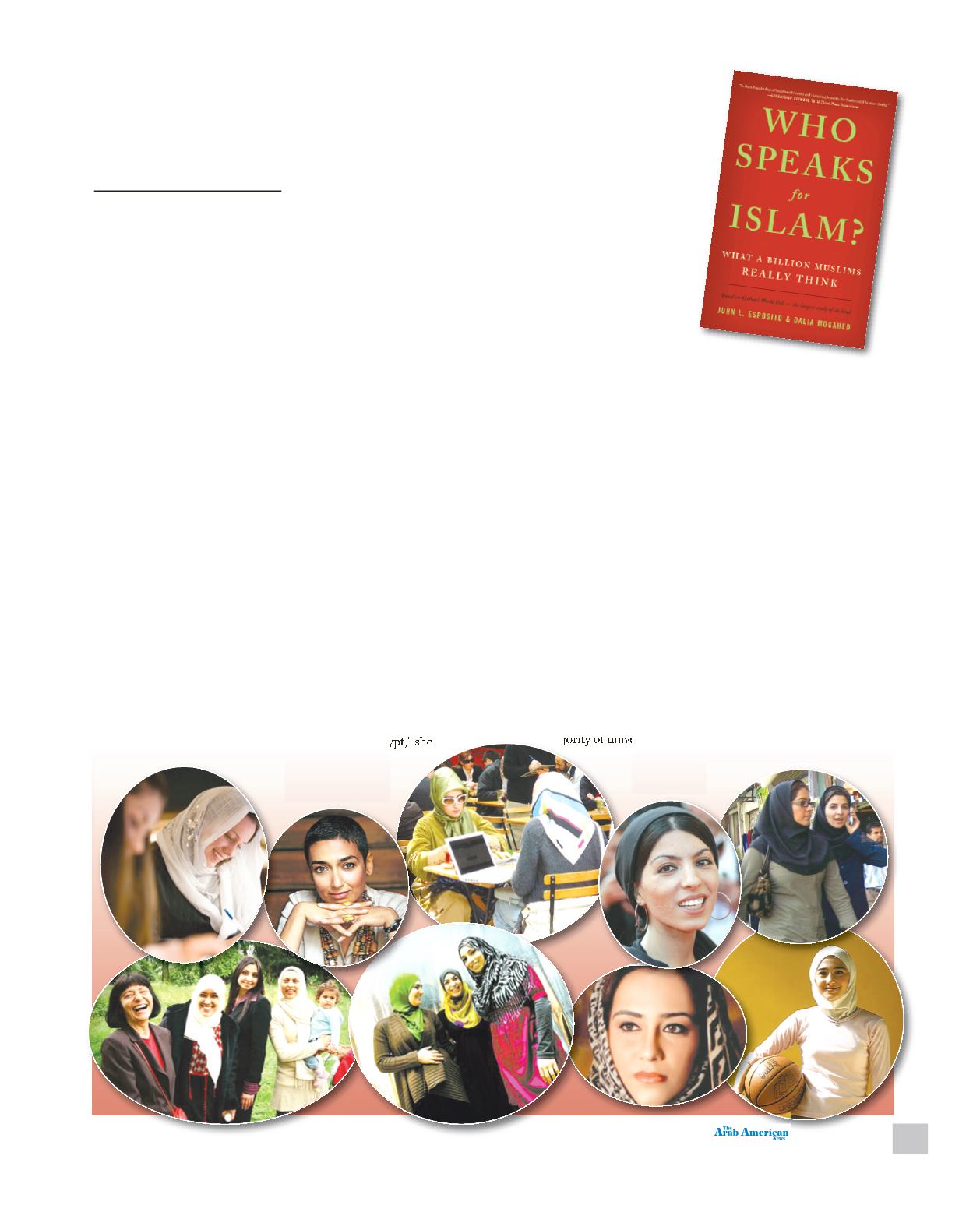
Based on the largest and most in-
depth study of its kind, Who Speaks
for Islam? What a Billion Muslims
Really Think presents the remark-
able findings of the Gallup Poll of
the MuslimWorld, the first ever
data-based analysis of the points of
view of more than 90% of the global
Muslim community, spanning more
than 35 nations.
What do Muslimwomen want?
An excerpt from the book
Who Speaks for Islam
?
Based on the largest
and most in-depth study
of its kind,
Who Speaks
for Islam? What a Bil-
lion Muslims Really
Think
presents the re-
markable findings of
the Gallup Poll of the
Muslim World, the first ever data-based
analysis of the points of view of more than 90%
of the global Muslim community, spanning
more than 35 nations.
Ramadan
20
10
21


